Fellows select one of four tracks to develop their skills in clinical rheumatology, clinical research, laboratory research, or medical education (with option for certificate).
| Clinical Track | Clinical Research Track | Laboratory Research Track | Certificate Medical Education Track | |
|---|---|---|---|---|
| Length of Fellowship | 2 years | 3 years | 3+ years | 2 Years |
| Prerequisites | Any fellow | Any fellow | Any fellow (even without a PhD) | Accepted Statement of Intent WUTPP application |
| Time of Declaration | Any point in fellowship | November of first year of fellowship with commitment no later than end of January | November of first year of fellowship with commitment no later than end of January | February of first year of fellowship |
| Additional Earnings | N/A | Masters in Clinical Science Investigation | Post-doctorate | WUTPP certificate |
The clinical track is a two-year fellowship that prepares trainees for careers dedicated to patient care. Clinical assignments at Barnes-Jewish Hospital, the Center for Advanced Medicine, Village Square, and the John Cochran St. Louis VA Medical Center are scheduled throughout two years of fellowship for honing clinical skills.
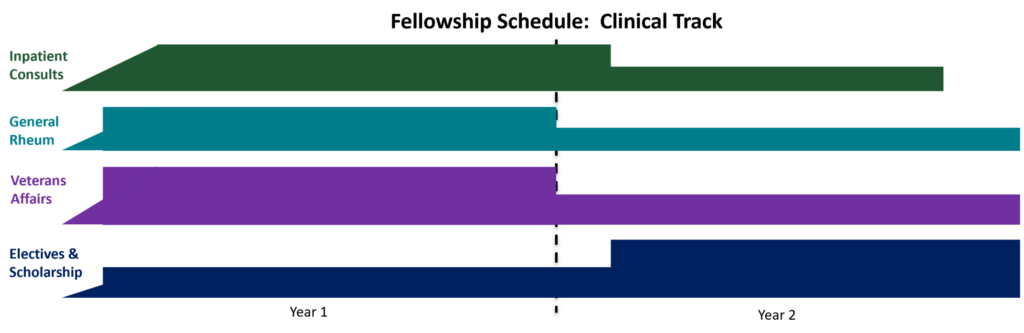
Graduates of our clinical track are successful rheumatologists and leaders.
- About 60% enter careers in academia, and 40% pursue community-based rheumatology.
- A substantial number of fellows complete the RhMSUS certification
- All fellows complete a scholarly project during their training. Some examples include:
- Bhandari S, Bhandari S, Byers DE, Witt C, Huecker J, Sen D. Trends and outcomes of lung transplant listings for connective tissue disease-associated interstitial lung disease (CTD-ILD): A 20-Year analysis from the organ procurement and transplantation network database. Semin Arthritis Rheum. 2026 Mar 12;78:152959. doi: 10.1016/j.semarthrit.2026.152959. Epub ahead of print. PMID: 41833236.
- Gad I, Podgorski C, Springer K, Bishnoi A, Rooney DM, Zickuhr L. Pilot Study: Development and Evaluation of Validity Evidence of a Low-Cost, Low-Fidelity Hand Model to Teach Clinical Assessment of Small Joint Swelling in Inflammatory Arthritis. J Clin Rheumatol. 2025 Sep 1;31(6):217-221. doi: 10.1097/RHU.0000000000002252. Epub 2025 Jun 16. PMID: 40521998.
- Babiker-Mohamed MH, Bhandari S, Ranganathan P. Pharmacogenetics of therapies in rheumatoid arthritis: An update. Best Pract Res Clin Rheumatol. 2024 Dec;38(4):101974. doi: 10.1016/j.berh.2024.101974. Epub 2024 Jul 20. PMID: 39034216.
- Murray J, Ramirez-Gomez A, Cahill M, Deptola A, Diffie C, McDonnell P, Metzler JP, Olafsen NP, Zickuhr L. Workshop, Assessment, and Validity Evidence for Tools Measuring Performance of Knee and Shoulder Arthrocentesis. MedEdPORTAL. 2023 Apr 13;19:11309. doi: 10.15766/mep_2374-8265.11309. PMID: 37064429; PMCID: PMC10101652.
- Rana A, Witt A, Jones H, Mwanthi M, Murray J, Zickuhr L. Representation of Skin Colors in Images of Patients With Lupus. Arthritis Care Res (Hoboken). 2022 Nov;74(11):1835-1841. doi: 10.1002/acr.24712. Epub 2022 Jul 30. PMID: 34057307.
- Kannuthurai V, Murray J, Chen L, Baker EA, Zickuhr L. Health care practitioners’ confidence assessing lupus-related rashes in patients of color. Lupus. 2021 Oct;30(12):1998-2002. doi: 10.1177/09612033211045284. Epub 2021 Sep 16. PMID: 34528847.
- Lee I, Marshall B, Ranganathan P, Eisen S, Rajagopal R, Kim AHJ, Li T. Choroidal thickness in lupus nephritis. Lupus. 2020 Feb;29(2):205-209. doi: 10.1177/0961203319898765. Epub 2020 Jan 10. PMID: 31924146; PMCID: PMC6992474.
- Bhandari S, Bhandari S, Byers DE, Witt C, Huecker J, Sen D. Trends and outcomes of lung transplant listings for connective tissue disease-associated interstitial lung disease (CTD-ILD): A 20-Year analysis from the organ procurement and transplantation network database. Semin Arthritis Rheum. 2026 Mar 12;78:152959. doi: 10.1016/j.semarthrit.2026.152959. Epub ahead of print. PMID: 41833236.
Graduates enter leadership roles in rheumatology, such as…
| Leadership Positions | # of Former Fellows |
| Founder, Private Rheumatology Practice | 6 |
| Director, Rheumatology Specialty Clinic | 11 |
| Director, Research Center | 3 |
| Committee member, American College of Rheumatology | 6 |
| Rheumatology Division Chief | 10 |
| Medical Education Leader | 4 |
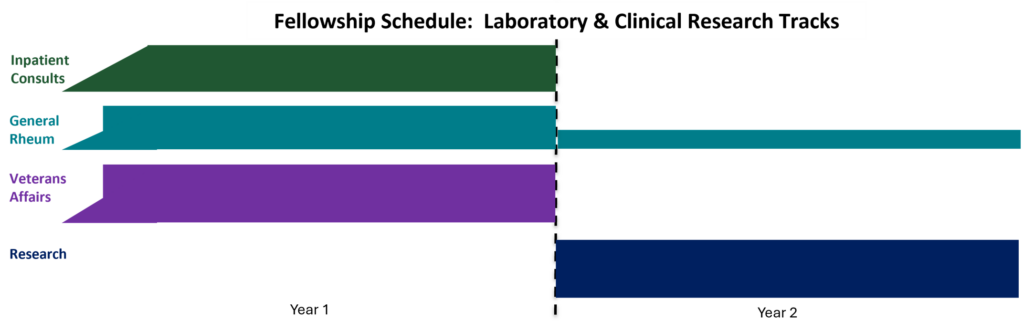
Fellows can gain hands-on experience in a clinical research program that is actively defining how systemic autoimmune diseases are studied, measured, and treated. The WashU Lupus Center anchors a portfolio of patient-centered investigations that includes prospective cohort studies examining disease activity and damage accrual, clinical endpoint development for clinical trials — including work informing how the field selects and validates outcome measures in future registration studies — and interventional clinical trials including CAR-T and T cell engagers in various rheumatic diseases. These projects each have direct implications for clinical practice and public health guidance. Fellows can contribute to 1) ongoing analyses within established patient registries available for lupus, vasculitis, B27-positive spondylarthritis and uveitis, and new registries under development for Sjogren’s disease and IgG4-related disease, rheumatoid arthritis 2) develop de novo research questions using longitudinal clinical data, 3) engage with the methodological challenges of studying a heterogeneous, relapsing-remitting disease in real-world populations, and 4) learn the intricacies of leading clinical trials at a major academic center.
A defining feature of the division’s research environment is its explicit commitment to health equity — investigating how race, socioeconomic position, and access to care shape clinical outcomes for those with rheumatic diseases and designing interventions to close those gaps. This work sits at the intersection of clinical epidemiology, implementation science, and community engagement, offering fellows exposure to study designs and analytic frameworks increasingly central to academic rheumatology. Trainees are supported through mentored scholarship tracks with protected time, faculty who hold active extramural funding, and a fellowship structure that treats research productivity as a core deliverable rather than an elective pursuit.
For those with a strong interest in pursuing clinical research and are seeking in-depth training, we offer the option to obtain an Master of Science in Clinical Investigation (MSCI) degree. This combines coursework with a substantive research project to become an independent clinical research investigator.
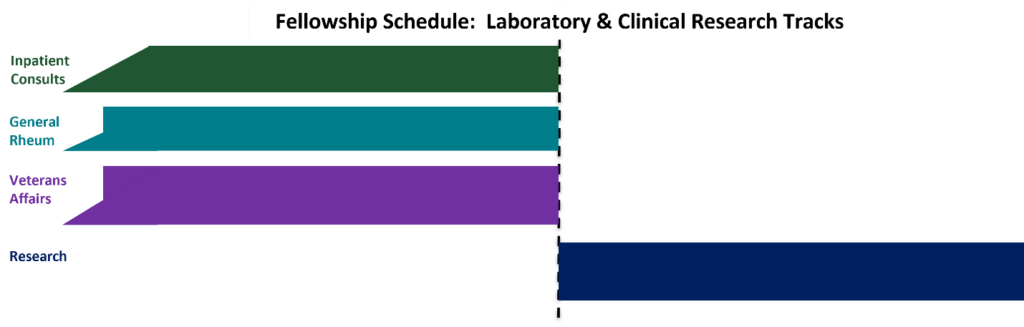
Historically, this has been the most successful track for research-focused rheumatology fellows when accounting for career development grants (including NIH K08 or K23), awards (including the American College of Rheumatology’s Distinguished Fellow Award), and subsequent recruitment into high-profile faculty positions as independent investigators. In fact, the two of our most recent tenure-track faculty members to join our division are both K08 and Distinguished Fellow Awardees (Dr. Zhao and Dr. Paley). In the past 10 years, WashU Rheumatology fellows in the laboratory research track have obtained a total 14 career development awards from federal and private funders such as the Rheumatology Research Foundation that have launched their independent research careers.
What makes the WashU lab research experience so rich is the abundance of world-class investigators that work in a highly collaborative environment executing highly rigorous research leveraging state-of-the-art research facilities. WashU Rheumatology alone has 10 principal investigators running federally funded bench-focused research groups spanning both basic and translational science projects, including regulatory T cell biology (Dr. Hsieh), identification and targeting of pathogenic T cells in B27-mediated diseases (Dr. Paley), genetic contributions to hidradenitis suppurativa (Dr. Roberson), interferon biology related to virus infections and autoimmunity (Dr. Lenschow), nanoparticle engineering (Dr. Pan), developing novel therapeutics for osteoarthritis and inflammatory arthritidies (Dr. Pham), complement biology (Drs. Atkinson and Kim), and natural killer cell biology (Dr. Yokoyama). But the research opportunities can extend to other divisions and departments across the university if desired.
For those with a strong interest without extensive prior research (i.e. PhD) but are very interested in pursuing in-depth laboratory research training, we offer the option to obtain an Master of Science in Clinical Investigation (MSCI) degree that provides coursework and mentoring teams that potentiate the research being executed by the fellow. Furthermore, for those with exceptional early-stage physician-scientists without an advanced research degree, the Dean’s Scholar Program provides 2 years of protected research time to obtain career development awards. Regardless of the path taken, the training in this track creates fellows who are not merely trained in research methods but transformed into competitive, independently funded physician-scientists ready to lead their own research programs and define the next generation of rheumatologic discovery.
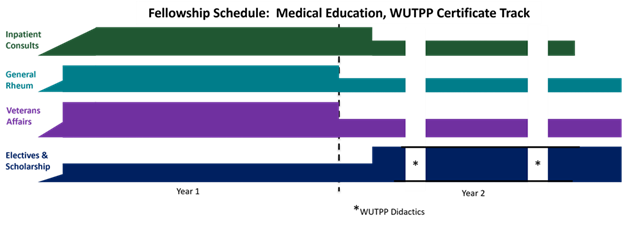
Calling all clinician educators! In partnership with the WashU Teaching Physicians Pathway (WUTPP), we offer a certificate for fellows aiming for careers in medical education. This program begins in the second year of fellowship.
Medical Education Track Programs:
| WUTPP Certificate Program | |
| Timing | 2nd year of fellowship |
| Applications | Statement of intent to WashU Rheumatology Fellowship Program Director WUTPP certificate application |
| Didactic learning | 2 two-week didactic seminars in the fundamentals of medical education |
| Experiential learning | Teaching medical students/ residents in the classroom |
| Required project | Create an online educational module |
| Research | Optional |
| Deliverables | WUTPP Certificate |
| Cost | Division covers costs |
Fellows in the medical education track follow the clinical track schedule, and time is allotted for WUTPP requirements. Fellows who graduate from our medical education track are prepared to lead successful careers as clinician educators and leaders in rheumatology.
- Fellows in the medical education track enhance the didactic teaching at WashU. Examples include:
- Case-based sessions on gout for the Internal Medicine Clerkship
- Knee and shoulder injection workshops for the Internal Medicine Residents
- Musculoskeletal physical examination skills instruction for the Rheumatology Fellowship
- Fellows in the medical education track conduct nationally recognized scholarship
- Development of Rheum2Learn modules for the American College of Rheumatology
- Published curricular materials
- Medical education-related abstracts, posters, and podium presentations at national meetings
- Fellows in the medical education track enter education leadership positions upon graduation
- Core Faculty in Internal Medicine Residency and Rheumatology Fellowship Programs
- Remediation experts in graduate medical education
- Coaches for medical students